
RAZON MM-TG / Floor tiling system
Hollow-free floor tiling starts below the tile.
Hollow free tiling is achieved by a system engineered &
perfected by RAZON. RAZON MM-TG pairs MM-101B in
the bedding mortar with TG-135 in the cement
slurry. Tiles sit solid, and hollow sound is practically eliminated.
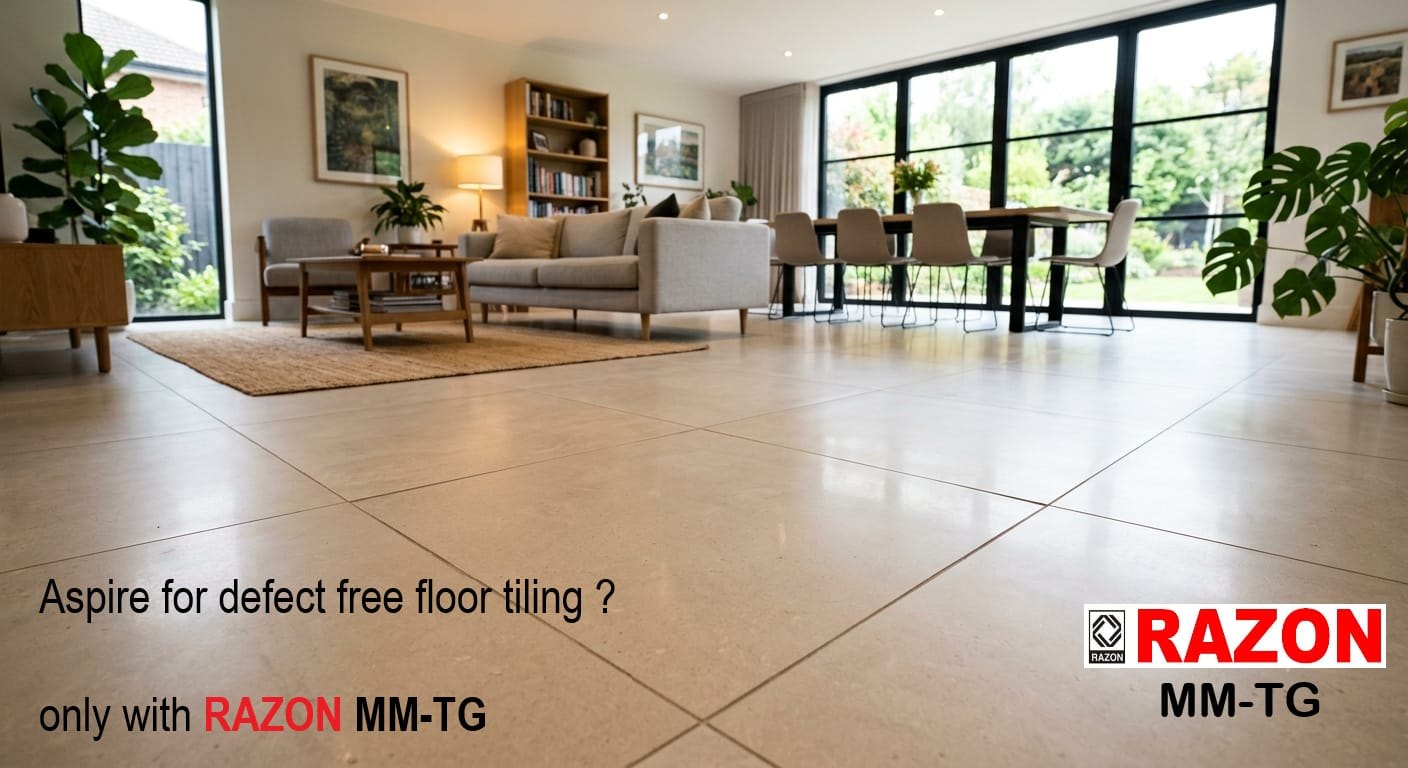
- Eliminate hollow sound in tiles
- Used for marble, vitrified, ceramic tiles
- Method of Use & Training manualFree of cost
- Trusted by Quality Conscious Developers / Contractors
From the Razon MM-101B & TG-135 datasheet. Hero image is
illustrative.
Hollow tiles are a bedding problem, not a tile problem.
What goes wrong under the tile
Tap a finished floor and it sounds hollow. Hollow sound, loose
tiles and tiles that lift are the call-backs that land on the
contractor and the builder. The tile is rarely at fault. The bond
beneath it is.
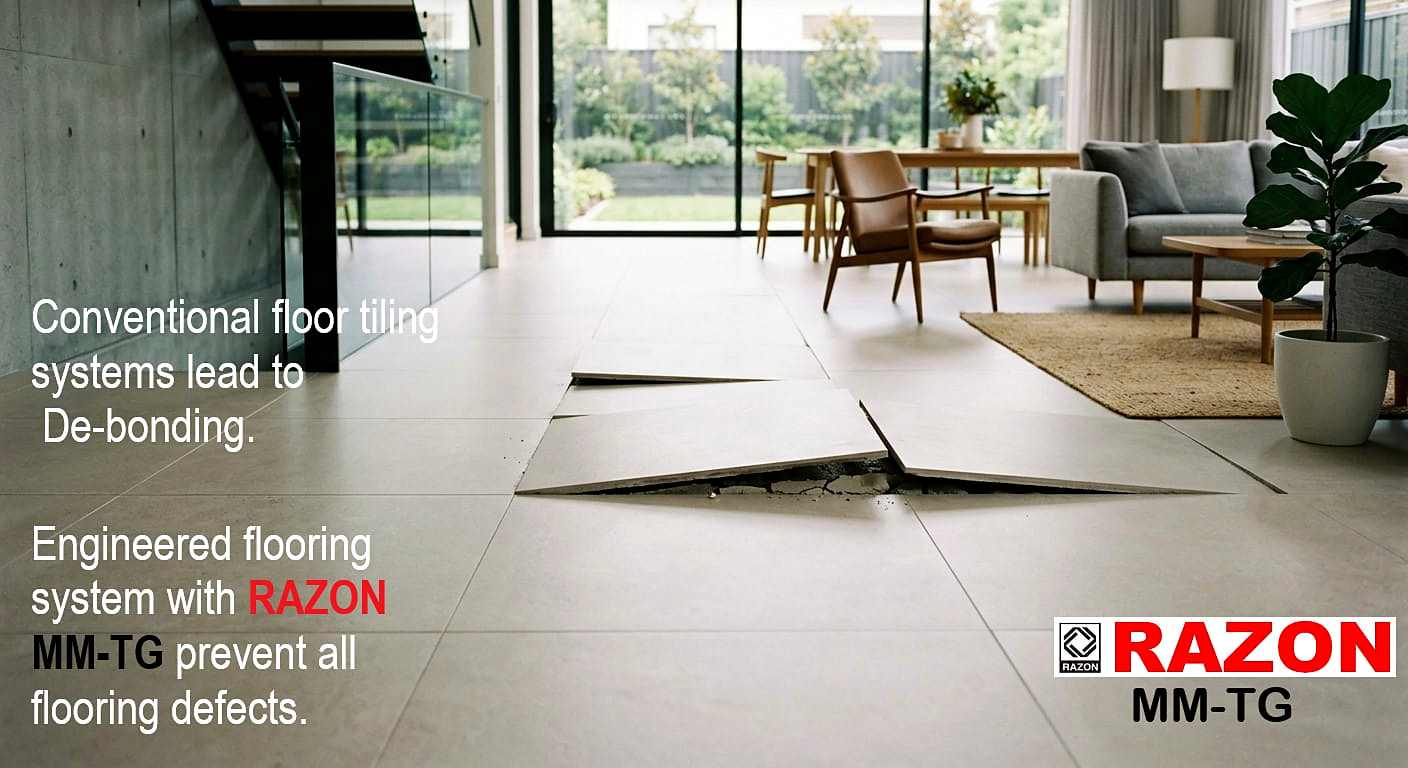
Tiles that lift
Weak adhesion lets tiles loosen and de-bond, and in time they
detach.
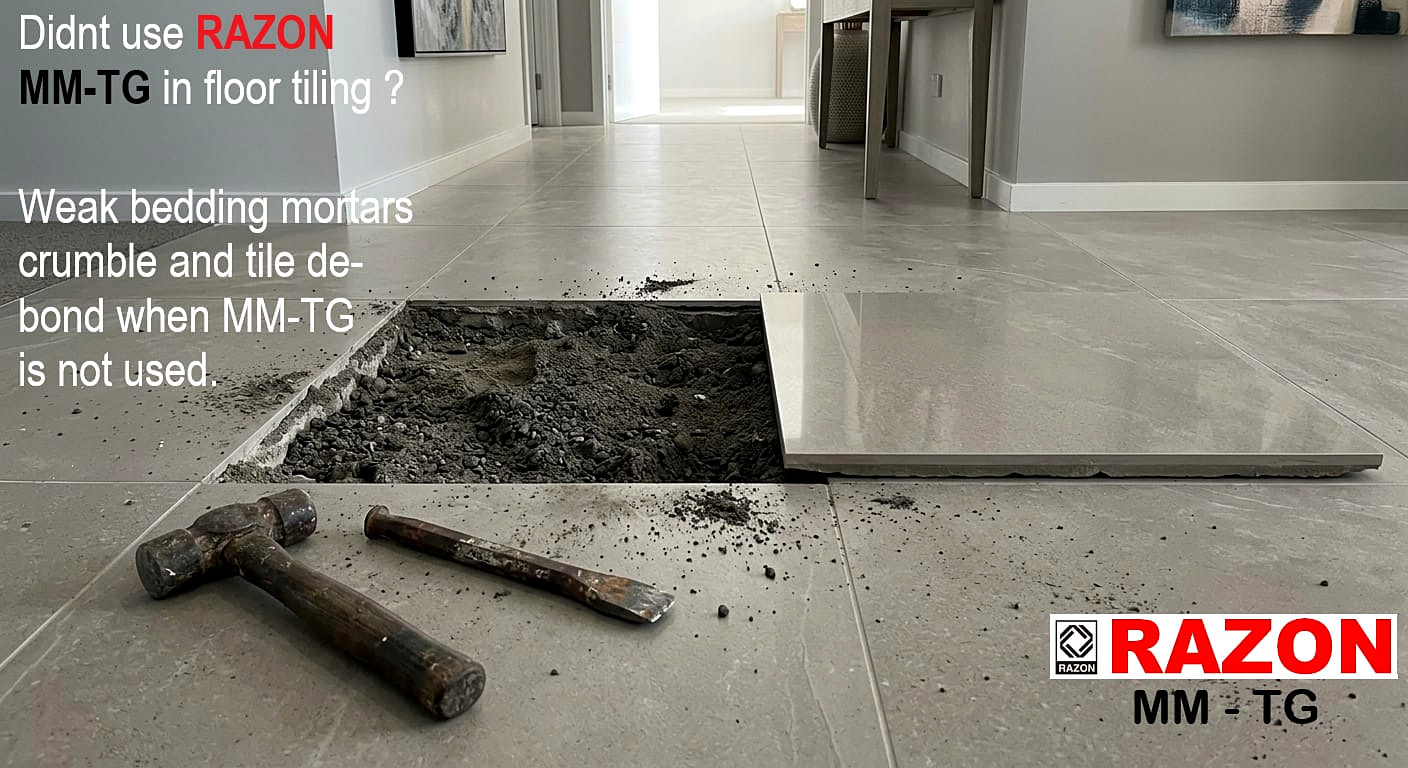
Does this situation appear familiar?
Weak bedding mortar crumbles. Not improving is a choice.
-
The slurry doesn’t flowWithout an additive, the
slurry leaves patches of unbonded tile, even after tamping. -
It shrinksA plain 1:1 cement slurry is subject
to shrinkage. -
It bleeds into the bedBleed and segregation let
the slurry seep into the bedding mortar and leave voids under
the tile. -
The mortar stiffens, then gets waterMortar made
with manufactured or crushed sand stiffens early. Re-tempering
it with water weakens it.
Seeing this on a site you know?
Describe what you’re finding and Razon’s team will suggest where
to start.
Why the usual fixes fall short
What sites try, and what still goes wrong
Every site has its own workaround. Each one treats a symptom, adds
cost, or depends on the mason getting it right on the day.
| What sites try | Why it falls short | With RAZON MM-TG |
|---|---|---|
| Add more cement to the slurry / mortar |
A richer plain cement slurry or mortar still doesn’t work, it still shrinks and still bleeds into the bedding. You pay more and the voids stay. |
TG-135 fixes flow, shrinkage and bleed, so you don’t buy your way out with cement. |
| Switch to a tile adhesive |
It works, but it is a premium product spread over the whole floor, and cost climbs with every square foot, and what happens when the thickness unknowingly increases? |
An adhesive-type bond from a cement slurry, at a fraction of the cost. |
| Hunt for the “right” sand |
Manufactured and crushed sand varies from load to load. The mix stiffens or slumps, and the mason compensates with water. |
MM-101B holds working time for 6 hours and strength steady despite minor variation in sand gradation. |
| Hack the bed with the trowel (“khacha”) |
Puncturing the bedding is meant to improve contact, but the peaks and valleys it leaves still trap voids. |
TG-135 slurry fills the valleys and peaks of the bedding, so hacking is no longer needed. |
What would it cost on your floor?
Share your area and how you tile today, and get a like-for-like
comparison.
The RAZON engineered floor-tiling system
A decades experience, a solution which rewards.
Add MM-101B to the bedding mortar and TG-135 to the cement slurry
above it. The mortar becomes dense and workable; the slurry
becomes a continuous, high-tack bond coat between mortar and tile.
Patchy bond, porous bed
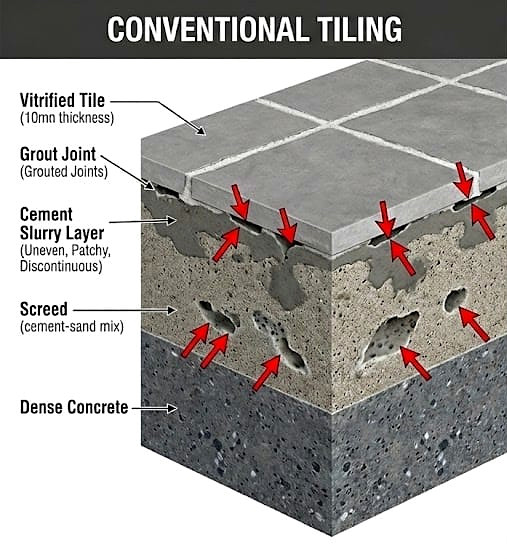
- Patchy slurry leaves unbonded areas under the tile.
- Air voids in the bedding mortar weaken the support.
- Weak contact: hollow sound, and tiles that can lift.
Continuous bond, dense bed
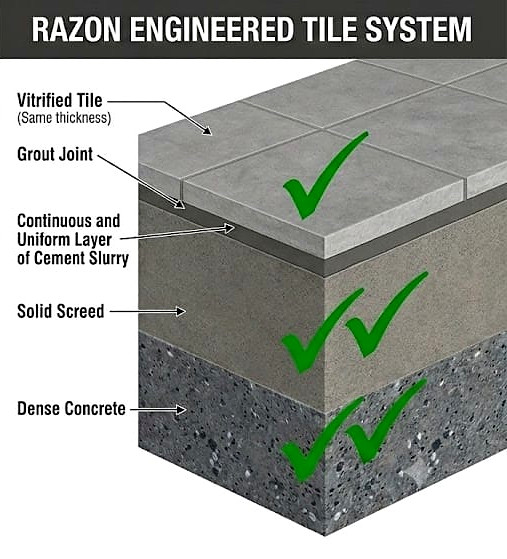
- A continuous, uniform TG-135 slurry layer.
- Dense MM-101B bedding mortar, compacted without extra water.
- Full contact from tile to slab, so tiles sit solid.
TG-135
Powder additive for the cement slurry under the tile. Makes it
cohesive, tacky and non-bleeding.
- Dose
- 5–6 kg per 50 kg of cement (floors)
- How
- Stirred into the cement slurry with a mechanical stirrer
- Cement
- OPC, PPC
- Packs
- 5 and 20 kg bags
- Shelf life
- 1 year, sealed, away from moisture
Try the system on your next floor.
Request a sample of MM-101B and TG-135.
See RAZON MM-TG explained
Watch the video
If the video doesn’t play,
watch it on YouTube
(opens in a new tab). Site photograph from Razon’s datasheet.
Want to see it on your own site?
Razon recommends a site trial with your sand, cement and mason.
Book one.
Why it works – Razon’s engineered flooring system.
What each additive changes, layer by layer
MM-101B: liquid additive
Adding it alleviates hollowness at the source, because:
-
Up to 6 hours of working timeThe mortar
stays workable through the laying shift. -
No re-temperingThe mason never has to add
water back to stiffened mortar. -
Self-curingMortar gains strength without
curing. -
Better compaction, higher densityImproved
wet compaction increases the dry density of the mortar. -
Easy to levelThe mason levels by feel and
depends far less on water. -
Bonds to the RCC in thin sectionsBetter
bond to the slab even in slim beds, up to 15 mm. -
Holds shape in thick bedsNo sag or
shrinkage deformation even at sections up to 75 mm. -
Doesn’t crumbleAt 28 days, the mortar is
difficult to break with a hammer & chisel. -
Lower permeabilityHigh-density mortar is
less permeable, which helps limit rising dampness.
TG-135: powder additive
Adding it alleviates hollowness under the tile, because:
-
It flowsWithout additives the slurry has no
flow, leaving unbonded patches even after tamping. -
Less shrinkagePlain 1:1 cement slurry
shrinks. TG-135 reduces it. -
No bleed, no segregationThe slurry stays a
distinct layer instead of seeping into the bed and leaving
voids. -
High tack for smooth tilesVitrified tiles
are smoother and need a tackier slurry. -
Maximum contact under a notched trowelNotched ridges of TG-135 slurry give near full contact,
practically eliminating hollowness. -
Self-curingPlain slurry needs external
curing; with TG-135 no water curing is required. -
Adhesive-type bondPull-off adhesion above 1
N/mm² at 28 days (ASTM D 4541). -
Adhesive-like performance at a fraction of the
costA sure route to practically eliminating hollow sound.
Ready to test an engineered flooring system.
Request for a site demo.
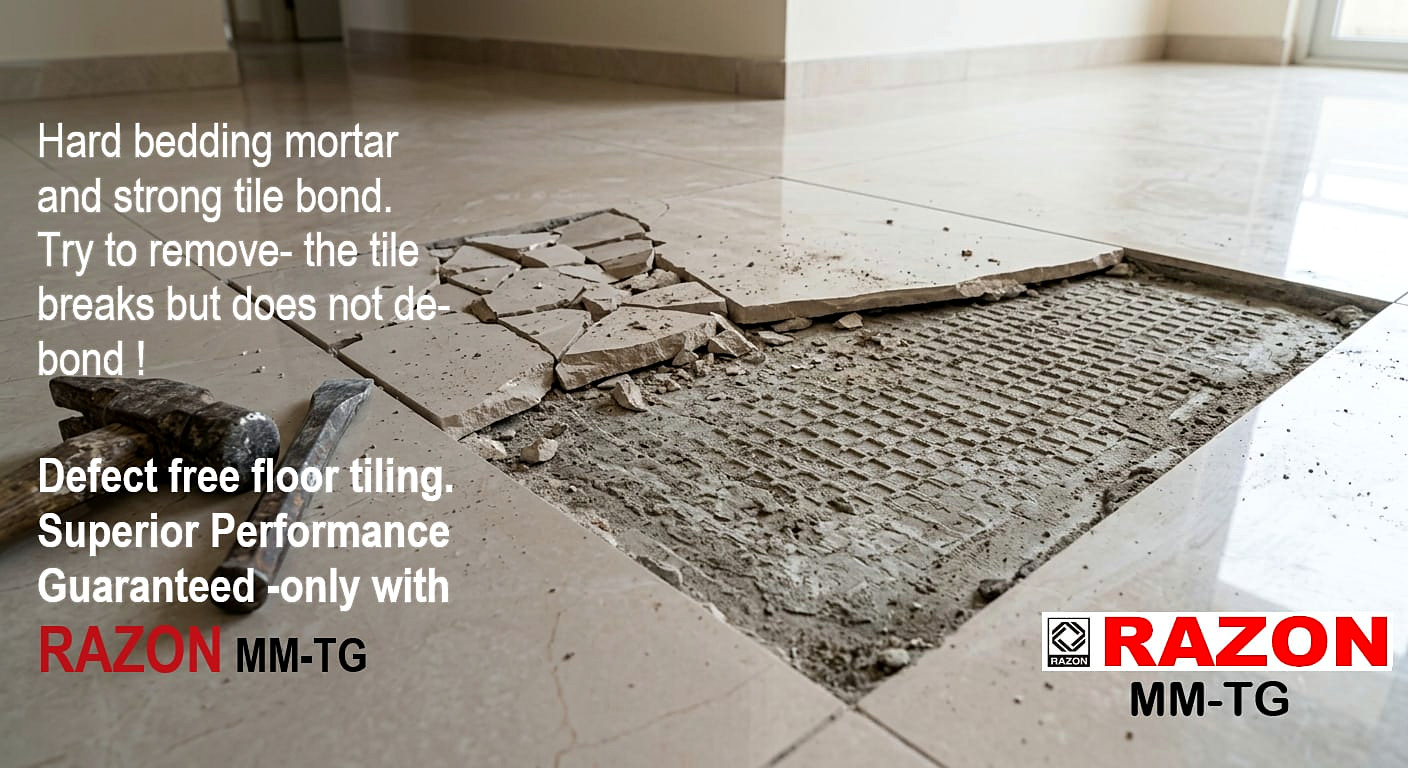
> 1 N/mm²
If you try to remove a tile after 28 days, it breaks, but the
mortar will not crumble.
From laying to a finished floor
-
Day 0Tiles laid on the MM-101B bed with TG-135 slurry. No water
curing. - After 24 hoursDo not spread water for curing.
- After 7 daysTest, hollowness shall be practically eliminated.
Datasheet Rev-002 (09/08/2022). Results come from Razon’s laboratory
and site trials; site materials and practice affect performance, so
a site trial is recommended.
Need the test reports?
Ask for the datasheet and supporting test reports for your
project file.
Plan your quantity
An estimate from the datasheet
Enter the floor area to see how much MM-101B and TG-135 the job
needs.
Have the RAZON team train your mason.
Book a site trial and Razon will help set up the first floor.
Common questions
MM-101B + TG-135
Do I need both MM-101B and TG-135?
The datasheet recommends both for floor tiling: MM-101B in the
bedding mortar and TG-135 in the slurry over it. Best results
come from using them together. Ask Razon if you want to trial
one first.
Will it work with manufactured or crushed sand?
Yes. MM-101B was developed to prevent early stiffening in m-sand
and crushed-sand mortars. It also suits natural sand and washed
silica sand.
Which cement can I use?
Both MM-101B and TG-135 are compatible with OPC and PPC.
How soon can the floor be used and grouted?
Foot traffic is permitted after 24 hours, and cementitious
grouting can be done after 24 hours. Epoxy grout needs the
bedding mortar and binder to set completely, which may take 5–7
days.
Can TG-135 be used on walls?
Yes. TG-135 is useful for wall and floor tiling. For walls, mix
9–10 kg per 50 kg of cement into a paste and apply it to the
wall and the tile with a notched trowel.
Is the performance guaranteed?
Results depend on site materials and practice, which are outside
Razon’s control. That is why Razon strongly recommends a site
trial with your own sand, cement and mason before full use.
Still deciding?
Ask Razon’s team anything about your floor, your materials or
your timeline.
Get defect-free floors on your next site.
Tell us about your site. Razon’s team will call back about a site
trial, samples and your quantity.
-
Call or WhatsApp+91 98814 94979 ·
+91 98905 29552 - Toll free1800 2700 885
- Emailinfo@razonengg.com
-
OfficeRazon House, 660 Taboot Street, Camp, Pune
411001