
Stop treating hollow tiles as a finishing problem.
Hollowness starts underneath the tile — with poor mortar compaction, voids, shrinkage, bleed, segregation and incomplete contact.
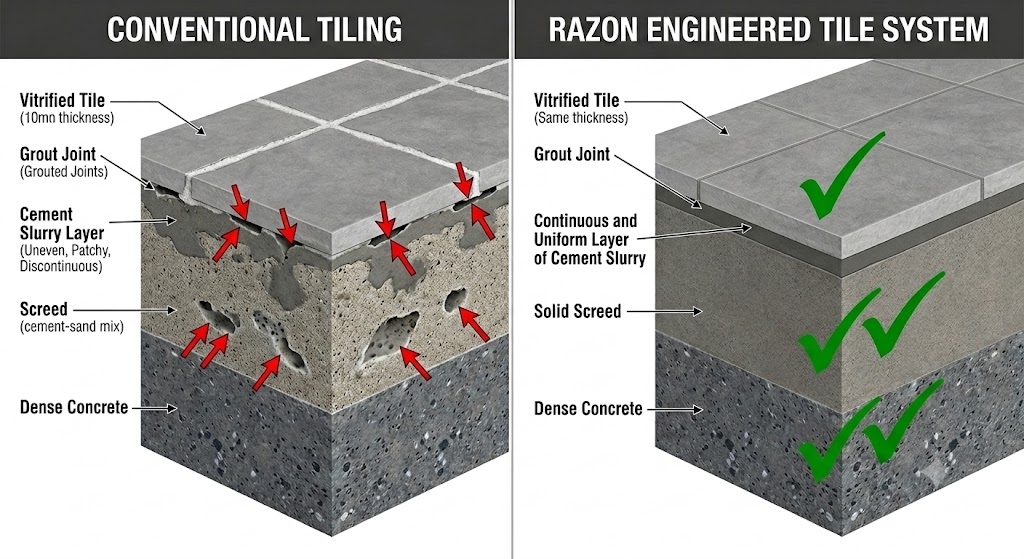
Beautiful tiles can hide an ugly failure underneath.
A floor can look perfect on handover and still contain unbonded areas. The complaint arrives later — hollow sound, movement, broken edges, debonding and repeated repair.
Conventional cement slurry can leave unbonded patches even after tamping.
A 1:1 cement slurry can shrink and compromise contact.
Slurry can seep into the bedding, leaving voids below the tile.
The smoother the tile, the more demanding the slurry’s tack and contact performance.
How exposed is your next floor?
Answer the questions below. This is not a lab test — it is a practical risk check for your installation process.
Uncontrolled variables reduce consistency.
Don’t patch the symptom. Engineer the layers.
RAZON MM TG combines two targeted interventions: MM 101B improves the mortar/bedding layer; TG 135 improves the cement slurry and tile contact layer.
Complete Sub-Bed Protection
Mortar Bedding
Contact Slurry
Same tile. Different system underneath.
The objective is simple: fewer voids, better contact, denser bedding and a more repeatable installation process.
| Installation variable | Conventional approach | RAZON MM TG approach |
|---|---|---|
| Mortar workability | Can lose workability and invite retempering | MM 101B: 5–6 hour pot life; designed to reduce retempering |
| Mortar compaction | Dependent heavily on site practice | Improved wet compaction and dry density |
| Levelling | Water can become the mason’s shortcut | Easier levelling without relying on extra water |
| Slurry contact | Patchy contact can remain beneath the tile | TG 135 + notched trowel targets consistent contact |
| Slurry shrinkage / bleed | Can contribute to void formation | TG 135 is designed to address these failure mechanisms |
| Vitrified tile bond | Smooth surface makes contact more demanding | Higher tack / adhesive-type bonding approach |
| Moisture pathways | Voids and porous bedding can become pathways | Dense mortar aims to reduce permeability and rising-dampness pathways |
Three changes your team can actually feel.
1. The mortar stays usable.
Longer pot life and improved workability reduce the temptation to “fix” old mortar by adding water.
2. The slurry actually contacts.
TG 135 changes the slurry behaviour and, with a notched trowel, creates a deliberate contact pattern under the tile.
3. The floor becomes a system.
Instead of treating mortar and slurry as commodity layers, MM TG engineers both interfaces that control hollow-sound risk.
Use the engineered system on the next floor — not after the complaint.
Tell RAZON what you are installing, and start with a site discussion, trial or commercial quotation.