
DON’T LET A BEAUTIFUL FLOOR SOUND HOLLOW.
A tile can look perfect on top—and still hide a problem underneath.
RAZON MM TG is engineered to attack the causes of hollow sound by improving
the bedding mortar and slurry bond system.
✓ Better slurry contact
✓ Stronger bond
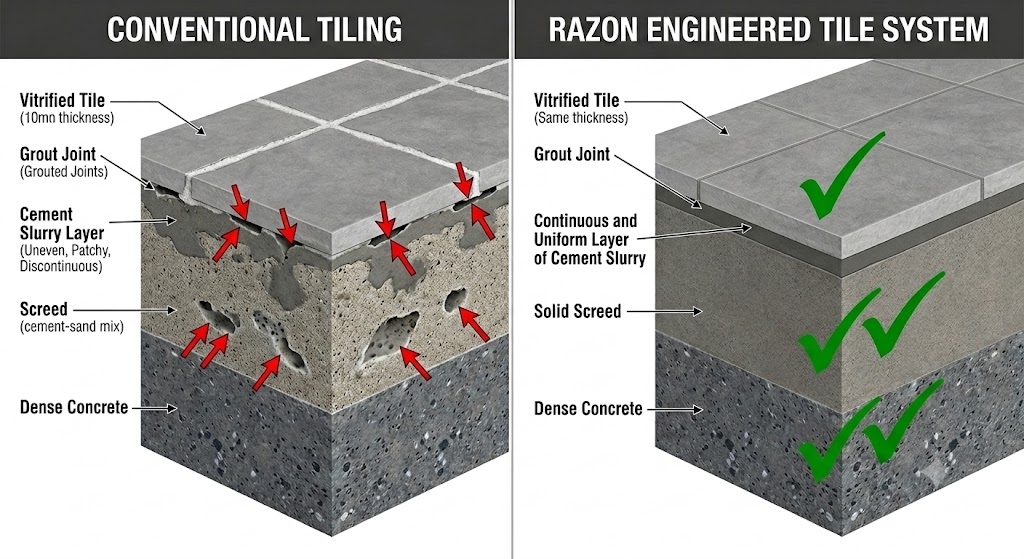
THE TILE IS NOT THE PROBLEM.
THE VOID UNDER IT IS.
When the bedding mortar or slurry fails to make proper, continuous contact,
the tile may be sitting over areas that are not properly bonded.
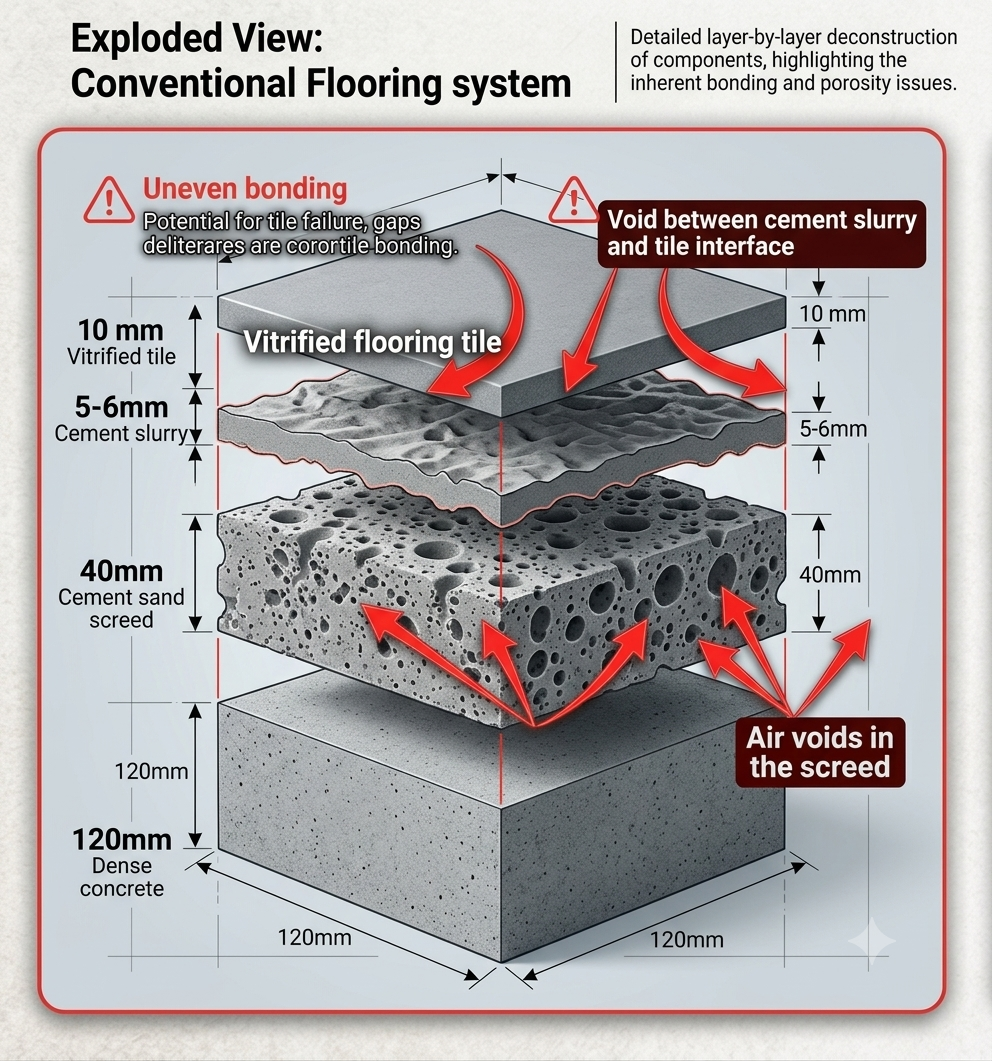
But the installation can still contain hidden un-bonded areas beneath the tile.
Yet the sound of a hollow area can reveal what the eye cannot see.
Complaint → investigation → breaking tiles → rework → labour → delay → loss of confidence.
THAT HOLLOW SOUND IS A WARNING.
What sounds like a small tap today can become a major quality complaint tomorrow.
The worst part? The floor may still look absolutely beautiful.
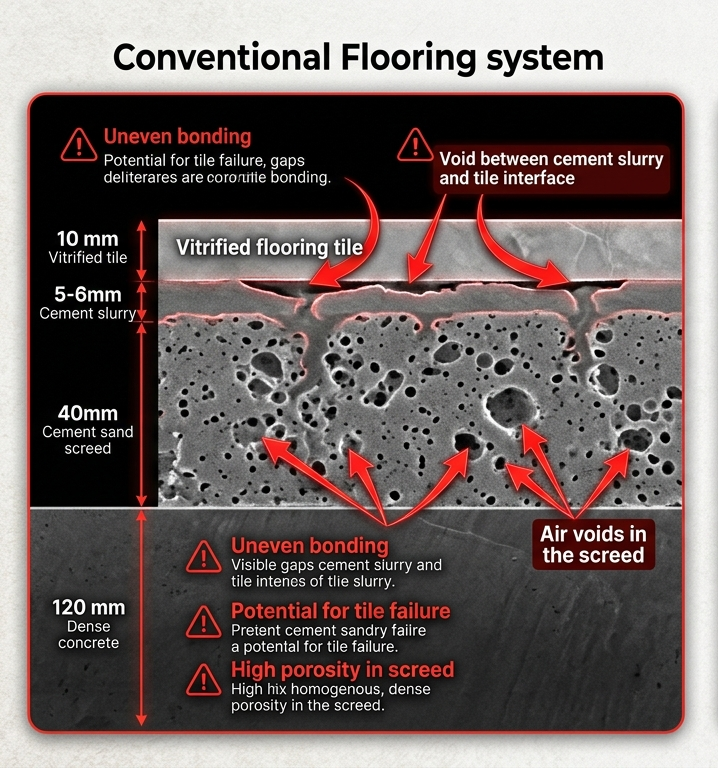
Don’t wait for the complaint to tell you what went wrong.
Build the bond correctly before the floor is handed over.
MORE TAMPING. MORE WATER. MORE CEMENT.
NOT NECESSARILY MORE BOND.
The instinct is often to compensate at the site. But if the material itself
does not behave correctly, extra effort does not automatically create a reliable bond.
❌ “Add more water.”
Water may make mortar easier to move, but dependence on water does not solve the underlying material behaviour. Excessive water can also compromise consistency and density.
❌ “Tamp the tile harder.”
Tamping cannot reliably eliminate every un-bonded patch when the slurry does not flow and wet the underside properly.
❌ “Use a simple 1:1 cement slurry.”
A plain cement slurry can shrink, bleed and segregate. As it moves into the bedding layer, voids can remain beneath the tile.
❌ “If it looks good, it is good.”
Appearance cannot tell you whether the tile has achieved continuous contact. Hollow sound is one of the clearest practical warnings that something underneath deserves attention.
you have to improve what is happening under the tile—not simply work harder on top of it.
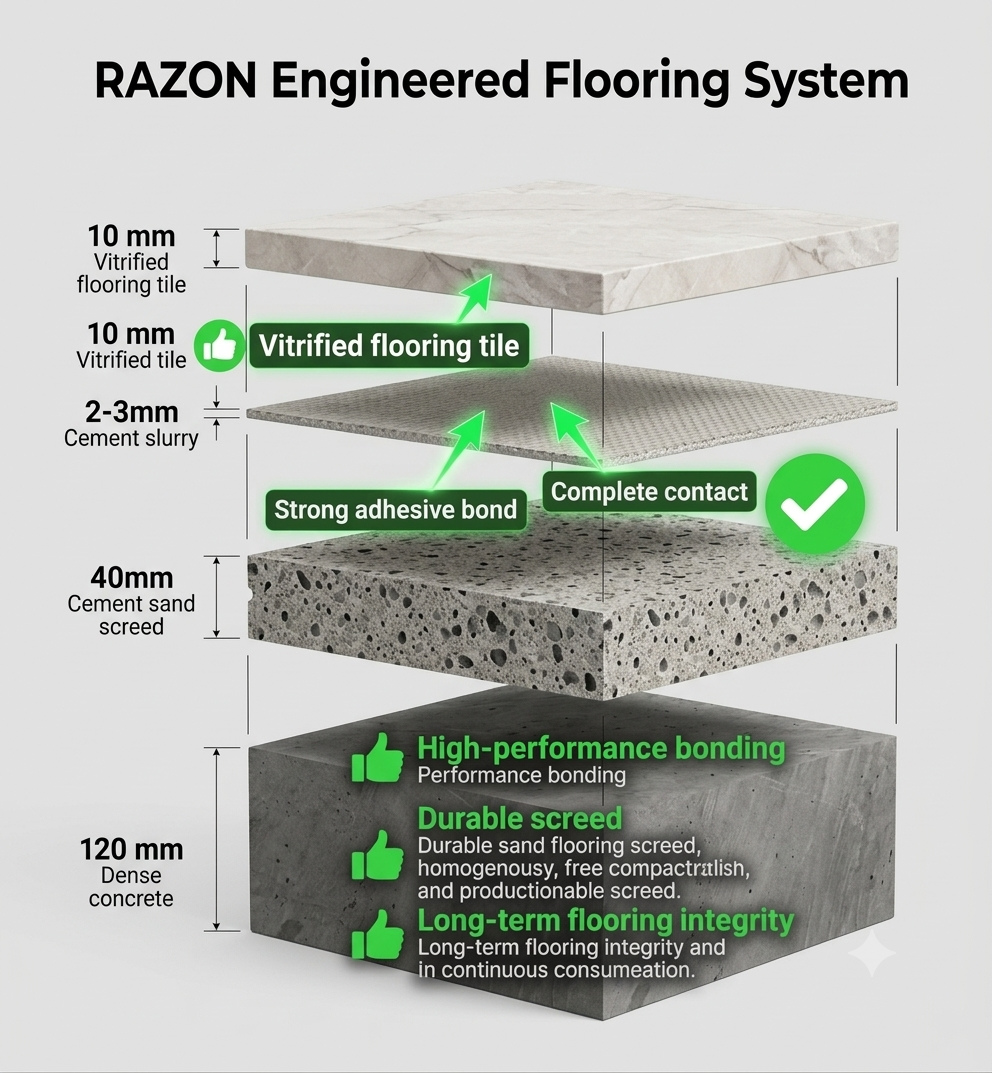
RAZON MM TG:
TWO ACTIONS. ONE OBJECTIVE.
Improve the bedding mortar with RAZON MM 101B and enrich the cement
slurry with RAZON TG 135. Together, they address workability,
compaction, flow, contact and bond where hollow sound begins.
MM 101B
Engineers the bedding mortar for longer pot life, easier levelling, better compaction and dimensional stability.
TG 135
Engineers the cement slurry for flow, wetting, tack and high-contact bonding beneath the tile.
- Pot life of MM 101B enriched mortar: 5–6 hours.
- No need for retempering the mortar.
- Mortar is less prone to sag and deformation.
- Improved wet compaction increases dry density.
- Mason can level the mortar easily with much less dependence on water.
- Better bond to RCC, including slim sections down to approximately 25 mm.
- Better dimensional stability in thicker sections up to approximately 75 mm.
- Reduced crumbling compared with conventional mortar.
- Higher-density mortar can reduce permeability and help reduce rising dampness.
FIX THE MORTAR.
FIX THE SLURRY.
FIX THE CONTACT.
Hollow sound is not solved by one magic gesture. It is attacked by improving the
material behaviour on both sides of the tile-bonding system.
RAZON MM 101B → BETTER BEDDING MORTAR
- 5–6 hour pot life
- No retempering
- Reduced sagging
- Better wet compaction
- Higher dry density
- Easy levelling with less water dependence
- Better bond to RCC at slim sections
- Stable at thicker sections
- Reduced crumbling
- Lower permeability / reduced rising-damp tendency
RAZON TG 135 → BETTER SLURRY CONTACT
- Improves slurry flow under the tile
- Helps reduce un-bonded patches left despite tamping
- Addresses shrinkage of plain cement slurry
- Reduces the problems caused by bleed and segregation
- Higher tack for smoother vitrified tiles
- Works with a notched trowel to maximise contact
- No external curing is required with TG-enriched slurry, as specified
- Creates an adhesive-type bond mechanism
- Designed to substantially reduce and practically eliminate hollow-sound incidence when correctly applied
DON’T BUY A TILE INSTALLATION.
BUY CONFIDENCE UNDER THE TILE.
The real value of RAZON MM TG is not another additive in your store.
It is the reduction of the hidden installation problem that can turn a finished floor into a rework problem.
CONVENTIONAL APPROACH VS RAZON MM TG
| Site requirement | Plain / conventional approach | RAZON MM TG approach |
|---|---|---|
| Mortar workability | Can become difficult as working time passes | MM 101B extends pot life to 5–6 hours |
| Retempering | May encourage water dependence | MM 101B enriched mortar needs no retempering |
| Levelling | More dependence on water | Easy levelling with controlled mortar behaviour |
| Compaction | Variable | Improved wet compaction and dry density |
| Slurry flow | Plain slurry may leave un-bonded patches | TG 135 improves flow and contact |
| Vitrified tile bonding | Smooth surface demands better tack | TG 135 provides higher tack / adhesive-type bond behaviour |
| Curing of slurry | External curing may be required | TG-enriched slurry does not require external curing, as specified |
| Hollow-sound control | Depends heavily on site technique | System is engineered to substantially reduce hollow-sound incidence |
THE SIMPLE LOGIC BEHIND RAZON MM TG
Prepare → Enrich → Place → Compact → Bond → Inspect.
Prepare
Prepare the substrate and materials according to the recommended installation procedure.
Enrich
Use MM 101B in the bedding mortar and TG 135 in the cement slurry at the recommended dosage.
Install
Use the recommended application method, including proper slurry distribution and notched-trowel practice where specified.
Deliver
Complete the floor with the goal of maximum practical tile contact and a substantially reduced hollow-sound risk.
DON’T TAKE OUR WORD FOR IT.
Put the RAZON MM TG system to work where flooring quality matters.
QUESTIONS PEOPLE ASK
Is RAZON MM TG just a tile adhesive?
No. It is positioned as a mortar-and-slurry enhancement system: MM 101B improves the bedding mortar, while TG 135 improves the cement slurry used to achieve better contact and bond.
Why use TG 135 if the tile is already being tamped?
Tamping cannot compensate for poor slurry flow, shrinkage, bleed, segregation or insufficient contact everywhere beneath the tile. TG 135 is intended to improve the slurry’s behaviour and contact.
Why does MM 101B matter to hollow sound?
The bedding layer influences how the tile is supported. Better pot life, levelling, compaction, density and dimensional stability help create a more consistent installation environment.
Can RAZON MM TG guarantee that every tile will never sound hollow?
No material should be represented as a substitute for correct substrate preparation and installation workmanship. RAZON MM TG is engineered to substantially reduce hollow-sound incidence when used correctly and according to the recommended procedure.
STOP HOPING THE TILE WILL BOND.
ENGINEER THE BOND.
If hollow sound, rework and customer complaints are problems you cannot afford,
don’t wait until the floor is finished to discover them.
When RAZON MM TG is used exactly according to the recommended formulation, preparation and application procedure, RAZON stands behind its engineered performance to substantially reduce hollow-sound incidence in the finished tile installation.
Important: This guarantee should be replaced/confirmed with your company’s legally approved warranty wording,
including applicable dosage, substrate, workmanship, exclusions and claim procedure, before publishing.
Request a Quote / Sample